Rover drill and payload
- Role
- Drill and payload team lead
- Team
- Four engineers
I led the four-person drill and payload team through design and manufacture. I coordinated design reviews and procurement, and worked with the rest of the rover team to integrate the subsystem.
Result
The team's fixed ring brush eliminated a separate drive; fitting it reduced nominal ground clearance from 25 cm to 20 cm
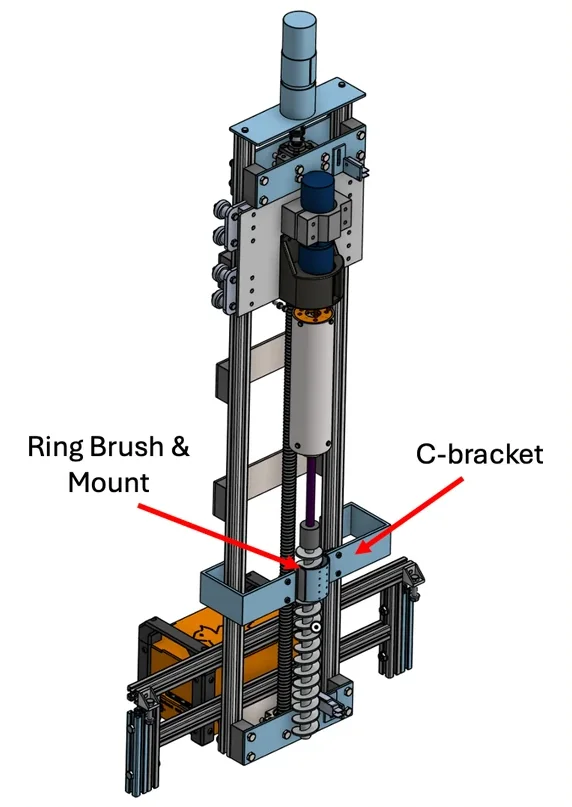 Drill mast with the fixed ring brush
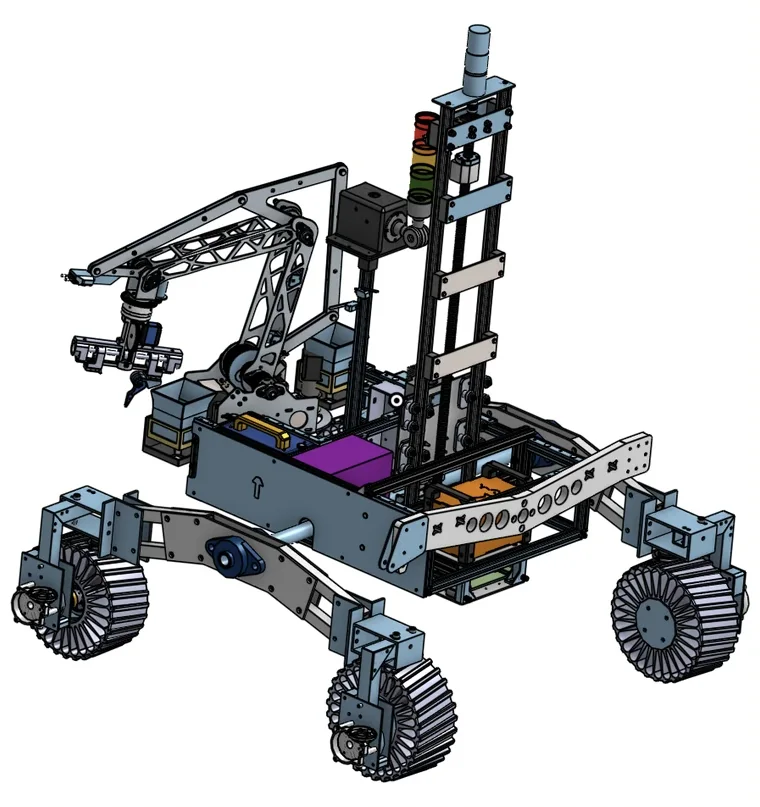 The mast installed on the rover
Problem
The drill and payload subsystem has to bore into the ground, lift a deep sample, drop it into an onboard store and weigh it. Our 2025 rover did this with an auger on a linear actuator and an actuated brush that swept the sample off the auger. In operation that brush arm took high bending moments, and its drive was one more moving part that could stop a sampling run.
Design
The 2026 subsystem was designed by the team as a whole. It keeps the auger from earlier years and changes three things around it.
- Vertical feed. A two-rail linear actuator built from 20 × 20 mm extrusion drives the drill up and down on a ball screw, chosen over a lead screw for its efficiency, low backlash and positional accuracy. Limit switches stop it at both ends of travel and the motor encoder closes the position loop. It drops in from above on four bolts, so it can be swapped quickly.
- Drill mount. The drill shaft is 60 mm shorter than in 2025 and runs in two bearing housings. With extra support bars on the mast, the assembly is stiffer and vibrates less while drilling and driving.
- Sample collection. The deep-sample collector slides out on its rails only when it is needed, so it stays clear of the auger’s path while drilling. Load cells in both payload boxes weigh what lands in them.
Iterations
The brush is where the design changed most between years, and moving to a fixed ring was a team decision.
- 2025, actuated brush. The brush ran on its own drive shaft and servo beside the auger. It saw high bending moments in operation, and the servo and shaft were a mechanism that could fail.
- 2026, fixed ring brush. We replaced it with a ring brush held in a C-bracket around the auger, so it touches the flights all the way round. That removed the brush’s separate drive. The cost was height: to engage the ring, the auger had to sit lower on the chassis, which cut nominal ground clearance from 25 cm to 20 cm. We accepted that for a simpler, lighter subsystem with fewer ways to fail.
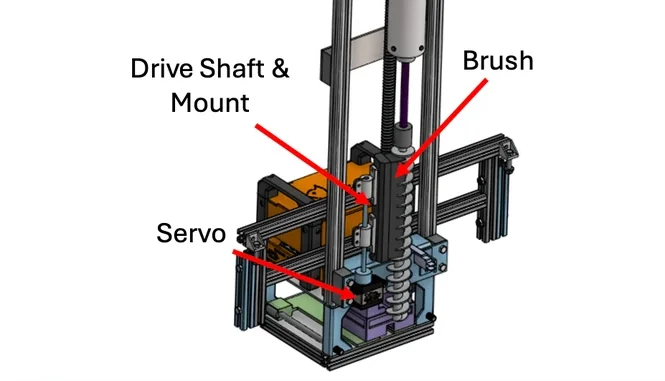 2025: actuated brush, with its own drive shaft and servo
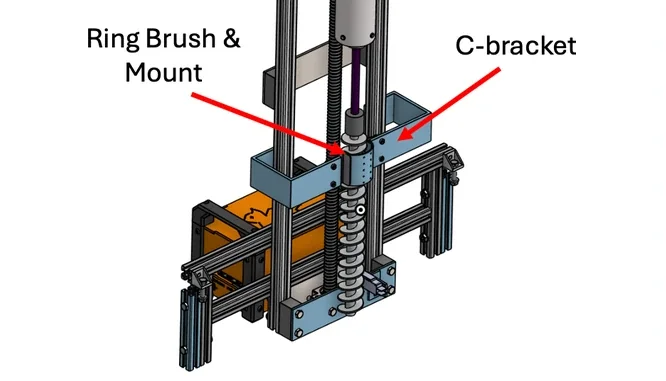 2026: fixed ring brush around the auger